Change and Chainsaws – an interview with Husqvarna
At Equip Expo in Louisville, I sat down with two executives from Husqvarna. Andreas Rangert is president of Husqvarna’s Forest & Garden Division in North America and I spoke with him last year at Equip too, so we pick up on some of the same topics.
Gent Simmons is Senior Vice President for Global Product Management & Development. He has lived in Sweden for years, and now spends time in the company’s Charlotte NC office, too.
We talked about products a bit, but I was mostly interested in asking about Husqvarna in America. The company has had a lot of turnover in the last two years. More than other OEMs? I can’t prove that, but it’s out there for sure. We talked about that. And we discussed rumors about the RedMax brand.
This text version of the interview is edited down slightly from podcast version, and you can find the OPE People podcast in the usual podcast places.
2025 Sales
OPE+
I just reported [on Husqvarna Group’s Q3 2025] sales were off 5%. I know that North America’s been a challenge for a lot of companies right now. For a lot of reasons. But that is spreadsheets and financial statements. How’s it going on the ground with dealers in North America?
Andreas Rangert
As you said, it’s been a challenging year with all the political volatility. We were very concerned in the spring. We had a pretty tough quarter one. I think we picked up quite well in quarter 2, and to some extent, through quarter 3 as well. So overall, I think the sentiments are changing. It’s still tough and on the higher ticket items. On the handheld side, we had a great year, especially with petrol handheld; that’s expected for North America. But also a little bit unexpected, because two years ago, in COVID, everything battery was supposed to take off. Now we see a rebound on our gas products. So that has been a good year for us.
Our dealer base is our key channel, clearly, and will remain so for many, many years to come. But overall, I think we tried to really make sure that we have our products available where our customers buy, which is in some areas, not possible, with only dealers. We are at Lowes, but we also need to expand that a little bit in other channels.
OPE+
What other channels?
Rangert
Farm Fleet channels, for instance. And also online. We are on Amazon and it’s a pretty strong channel for us. We are dominant there on the petrol side, that’s a smaller market for Amazon than battery. Robotics is coming along quite well online. So that’s another growing market for us, a growing channel.
OPE+
How about pro buyers? The pro market is interesting, and you can’t go direct to them, but I know Husqvarna has done a lot on the pro sales side.
Rangert
Yes, and I think we talked about it last year. We had an organizational change that we tried to go more pro, split up the pro and residential customer focus. And now we have changed back. So we are only one organization now, which works better for us. Not taking away the focus on the pro side. But overall, we sell the whole portfolio. We have some direct channels. I mean, we have tree care; we have some governmental business as well. But the organization we had when we sat here a year ago, we had just changed that. The one we have now works better for us.
OPE+
How do you help dealers with sales training? Is it different between a homeowner with a large property or a small landscaper with a couple trucks?
Gent Simmons
We have online training as a starting point for our dealers. It actually starts with our sales team so that they can help on the front lines with our dealers in the training. There’s nothing better than actually getting the hands-on face to face training that our territory managers bring. So we make sure they’re up to speed on all the different technologies, trends in the industry, selling points, features, et cetera. But then direct to the dealers and the channel partners, we also have an online training with Husqvarna University. It brings feature-benefit training, and certification training when it comes to our service side. Part of the journey we’re on right now is to enhance that. There’s been a lot of discussions internally about what we call PACK training, Husky PACK, harkening back to the days when we used to call ourselves proudly the Husky organization. Husky PACK is about products and customer knowledge. From that, we want to expand into webinars for our dealers, for our channel partners. And other ways we can empower the sales teams with training tools. We were talking just yesterday, to actually have sales aides and training tools our territory managers can take around with them and have face-to-face discussions. We need to empower our dealers and our channel partners and our sales teams so they can make sure they’re bringing the right product to the end customer in the end.
Rangert
We also have introduced a function a year and a half ago called the MDR, or Market Development Representatives. These are people in the field, typically young people, early in their careers, and they perform both demos and training sessions and help our customers to do arrange dealer days or whatever it may be.
Husqvarna North America personnel
OPE+
Can we talk about your people? I’ve had conversations with a few manufacturers here who say, “We’ve got new people from Husqvarna.” These are anecdotes, but when I hear them a couple times, I need to just ask. Is there anything to add to that or say about that?
Rangert
First of all, there’s a lot of rotation in our industry, right? We recognize people here that have been working for us. We also have some people with us that have worked for other companies. But yes, we have made reductions, not in the last one and a half years. But before that, we had to cut back a little bit and of course that made people seek other opportunities. And that’s fine. We’re on a different path now. We see some development in the right direction and we want to also capture the good people.
Simmons
Andreas is humble. He’s been in the North American organization now for a year and a half. I think Andreas has brought a stable situation back to Husqvarna North America. And I think you can pick it up in the spirit of the team here, with both the field teams and the Charlotte office. That stability sets us up to take the next step and start accelerating again.
RedMax brand
OPE+
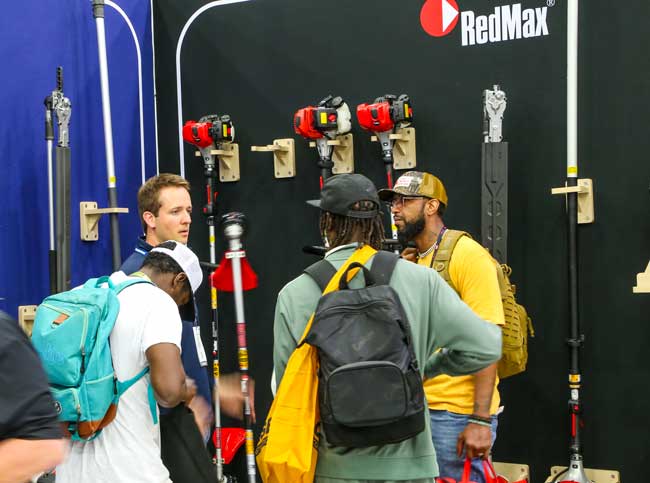
I’m curious about Red Max. Why is that a standalone brand, and is it doing what you want it to do?
Simmons
I will just jump right into a question we get a lot. What is the future of RedMax? And the future of RedMax is strong. For the foreseeable future, we have a RedMax brand. We have innovation investments planned for RedMax. And the reason why it’s going to remain a separate brand is because that brand actually has a completely different identity. Husqvarna has a core history on the forestry side that we have expanded well into the landscape industry and the landowner customers. We have our innovations in robotics on the Husqvarna side. But the RedMax brand brings strong equity into the landscape business. We want to serve those customers the best we can. They’re very loyal to that brand and we want to continue to bring them what they’re looking for. The rugged, tough, powerful RedMax brand. The future of RedMax is strong.
Electrification and Petrol
OPE+
Can we talk about battery and charging solutions? Where are your batteries made? What’s battery manufacturing like right now for you?
Simmons
Most of the battery packs are built in Mielec, Poland. When we started out in the battery journey, we were using pack-build partners, with all the cells sourced from cell suppliers. We’ve been moving that in-house over the years to get more control of the manufacturing process and the supply chain. It’s important that we get more control, not just in battery, but in general, of our supply chain.
The other question was about the battery business in general in general in North America. Our focus is still on bringing the customers they are asking for, which is our gas-powered solutions. But we are investing now for the future. A lot of homeowners have already shifted to battery and we have great solutions for them. And as we advance technologically with more runtime and higher performance, battery will be there for professionals. But right now in North America, it’s primarily gas, You see the numbers. It’s primarily a gasoline industry still.
Rangert
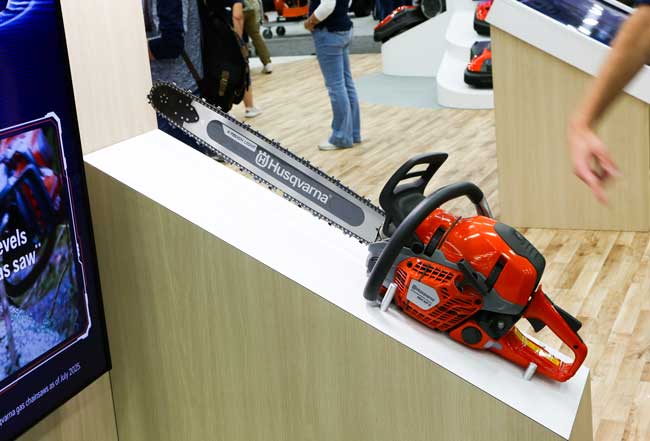
And we really want the customer to choose his power. That’s the way we try to position ourselves. When you see the new chain saw we have here. It’s a 50cc equivalent battery chainsaw. It’s equally good or even better in some cases. But we need to have a customer select what he wants for that application to serve him best.
OPE+
Right, but when I read your financial statements, the Husqvarna Group and its global statements, it’s really bleak for “petrol.” It could be read that way.
Rangert
It can be read that way. Our strongest markets are in Europe and they are much more advanced in battery. They’ve come much further. In total, I think we have 40% battery products right now and still majority still gas because the markets, you know, Latin America, Asia, still very much on gas. Here, it’s picking up, but it will take some years before it’s a 50/ 50 split even. So that’s where we say, we need to continue to invest in gas as well, and we do.
Simmons
There is absolutely nothing going on behind the scenes at Husqvarna that is giving up on innovating and developing and building new gasoline-powered engines and products. We are investing in innovating in that space, just like we’re investing on the battery side, just like we’re investing on autonomous products as well. So we see a future, the future of gasoline is strong. I have teams developing new engine technology and we’re looking at alternative fuels and how we can build more suited to alternative fuels or actually can run on flexible fuel options. And we’re not the only ones. We know that other manufacturers doing the same thing in the industry. I have a team working with battery handheld. I have a team working just with batteries. I have a team working with electrifying wheel products. At the same time, we’re bringing the market some petrol products because it’s what our customers want. We are very diverse in how we split our resources.
2026 – the year of the …
OPE+
Is there a particular segment you’re either really excited about for 2026 or one where you can steal market share?
Simmons
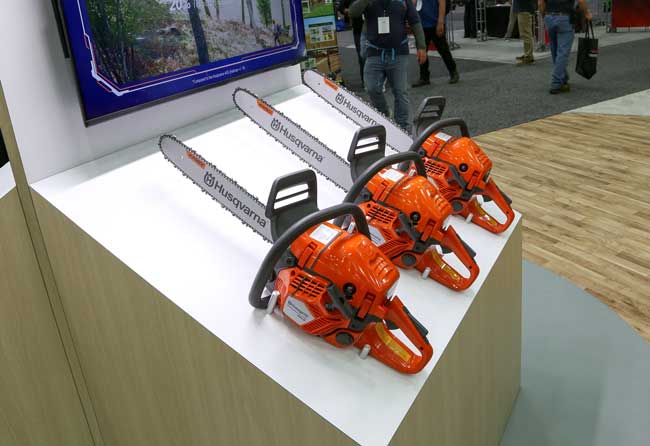
This is a chainsaw year. 2026 is the chainsaw year. The core spirit of Husqvarna is back in 2026 with chainsaws. The 550I XP, the new battery chainsaw, is being brought to market for 2026. We have two new batteries to go with it. We have the new 564 XP. And then we have an entire range of 400 series, our more landowner-based gasoline chainsaws. In that, we have a 445, a 450, and a new version that has an autotune carburetor on it. So battery pro, gasoline pro, gasoline landowner, all new for 2026.
Robotics and Automation
OPE+
Can we talk about robotics a little bit? Everybody’s entering this market, right? People still think of the Husqvarna as the original. Are you playing catchup now in a way? What are you doing to stay ahead?
Rangert
Having more players in the market is good; it creates the awareness of the category, which wasn’t here before. From our perspective it’s great. We’re making a lot of investments now. We have just this year launched a specifically developed machine for the U.S. market with grass heights and the big wheels and so on. Of course, wire free is the technology, no one buys wired anymore. But I think the main growth area we see right now is really in the pro side for robotics and there we are not alone, but we are ahead. We have the big machines over here today. We see great growth in that category from a small base but it’s really taking off in a good way. The good thing with the pro side is that they really see the benefit immediately, with the labor shortage we have now going on in the landscaping and also in the golf and sports industries. That’s where we see the majority of the growth right now, and we want to stay ahead on the residential side as well.
Simmons
Having a little bit of a peek behind the curtain, as I do with my colleagues over on the robotic side, maybe we should actually thank the competition. In some ways, it’s put an even more invigorated spirit on the R&D side to accelerate. Competition is a good thing in that sense.
OPE+
And how are so how is your messaging changing to dealers around robotics?
Rangert
I think we need to make our customers aware of Husqvarna robotic mowers and the value proposition, why should you choose us? Because we are premium, we are more expensive in many cases, and we need to justify that with basically the same things that you said before on handheld products, that is reliability durability, but also aftermarket support and the knowledge we have since being here in 30 years.
OPE+
My neighbor bought a competitor robot online, had it shipped to his house. He’s a smart guy. But he had a hell of a time with setup. I think this direct-to-consumer model with these robots could give them a bad reputation if setup is challenging.
Rangert
It puts a lot of demand on the development team, actually, to make sure that we have the customer in front of us when we develop the installation and everything.
Simmons
But the technology is advancing so fast right now. We’re moving from boundary wire technology to using reference stations and satellite RTK. That was a big leap. And now we’re looking at multiple leaps forward from vision systems, where we’re able to identify if there’s everything from an animal to a ball to whatever, and then you incorporate AI into that. And then you really get to a point where it’s just dropping em off, you know, and so the technology is going so fast. I think the shift in the next couple of years is going to take a lot of those unknowns and teething issues of new technology. It’s going to take them completely away. And so I think there’s big leaps right around the corner in autonomous mowing technology.
OPE+
What are you hearing from people at Equip Expo? Anything surprising that you’re hearing from event attendees about their requests, their desires, their input?
Rangert
What everybody or most people say is they love the brand. They want consistency now. I think we need to provide that consistency in the way we develop things, the way we approach our customers, the way we approach our channel partners, the way we pay attention to them.
Simmons
And they’re starting to see it. I think that’s been the most encouraging thing. Talking to our customers and channel partners just a couple years ago versus where we are today, I’m hearing more and more people say just what you mentioned there. We’re making some good moves. And it’s not just about new products. I think we’re starting to do a much better job on the support, the service, the supply chain challenges that we’ve had in the recent past. And we’re starting to hear that from our customers, from our channel partners. So the biggest request I’m hearing is ‘Keep it up.’