Online or in store? Dealers face a digital shift in how equipment is bought and sold
By Brian Ethridge
As consumer buying habits continue shifting online, the outdoor power equipment and landscaping industries are beginning to reassess how — and whether — ecommerce fits into their sales models.

For many dealers, websites have traditionally served as digital storefronts rather than transaction platforms. Inventory is displayed, leads are captured and sales are completed in person.
That structure is starting to face pressure.
Rowan Mockler, co-founder and CEO of Ekho, said many dealership websites fall short of modern expectations.
“You spend a fair amount of money on a website that is not state of the art,” Mockler said. “It’s cookie cutter, probably not super modern and importantly doesn’t have a transaction layer within it. So it’s really just a catalog of your inventory.”
From listings to transactions
The distinction between listing inventory and completing a sale online is becoming more relevant as buyer expectations evolve.
Consumers are increasingly accustomed to purchasing goods online, and some of those expectations are beginning to extend into equipment categories. In response, technology providers are working to bring more of the transaction process, including financing and documentation, into digital environments.
Despite that shift, many dealers remain cautious.
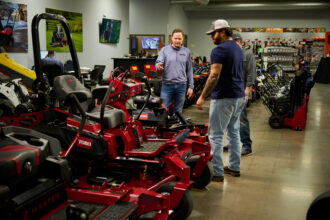
In addition to operational complexity, the sales process in OPE and landscaping equipment has long been relationship-driven. Dealers often rely on in-person conversations to guide buyers through product selection, financing and long-term service needs.
That dynamic can be difficult to replicate online, particularly for higher-ticket equipment or first-time buyers who may require more education before making a purchase.
As a result, some dealers view ecommerce less as a replacement for traditional sales and more as a supplemental channel — one that may serve a different type of customer.
Incremental potential
One of the primary concerns among dealers is whether ecommerce will reduce showroom traffic.
Mockler said early data suggests online transactions may be reaching customers who are not currently engaging with dealerships.
“We know, grounded in the data, that the majority of these sales are incremental,” he said.
He added that a portion of buyers indicate they would not have completed a purchase without an online option, suggesting digital channels may expand the overall market rather than replace existing sales.
That potential is especially relevant as the industry looks to engage younger buyers.
“This is an existential risk to the industry,” Mockler said, referring to the rising average age of equipment buyers. “If that continues to happen, sales drop off in an equal and opposite way.”
At the same time, questions remain about how those sales integrate into existing dealership operations. Dealers must consider how online transactions affect margins, trade-in opportunities and attachment rates for parts, accessories and service packages — all of which are key contributors to profitability.
The balance between convenience and control continues to be a central consideration.
Changing search behavior
In addition to how purchases are completed, the way customers research equipment is also evolving.
Some consumers are beginning to use AI tools, such as ChatGPT, as part of their buying process, alongside traditional search engines and dealership websites.
“Thirty percent of customers are using AI search during their research process,” Mockler said, citing internal research.
That shift could influence how dealer websites are structured and how inventory is surfaced online, particularly as AI-driven search becomes more common.
For dealers, that may mean placing greater emphasis on website performance, structured content and visibility across multiple digital channels.
Complexity continues to slow adoption
Despite growing interest, ecommerce in equipment sales presents logistical and regulatory challenges that are not present in many other retail categories.
Transactions can involve financing approvals, tax calculations, titling, registration and delivery coordination, often varying by state and product type.
Mockler said addressing those challenges has required significant groundwork.
“We spent 18 months mapping titling, registration, tax and fee workflows in every jurisdiction across the U.S.,” he said.
The complexity of those processes has been one of the main reasons adoption has lagged behind other retail sectors.
Even with new tools designed to simplify those steps, many dealers remain cautious about moving transactions fully online.
Service and long-term relationships
While much of the focus around ecommerce centers on the initial sale, dealers note that long-term value in the OPE industry is often tied to service, parts and ongoing customer relationships.
That raises questions about how online buyers engage with dealerships after the transaction is complete.
In some cases, digital tools may help establish those relationships earlier by capturing customer data and creating additional touchpoints. In others, dealers may need to adapt processes to ensure online buyers remain connected to the dealership for service and support.
The ability to maintain those relationships could play a significant role in how ecommerce strategies evolve within the industry.
What it means for OPE dealers
For OPE dealers, ecommerce adoption is likely to vary based on product mix, customer base and business model.
Lower-cost equipment and accessories may be more suited to online transactions, while larger or more complex purchases may continue to rely on in-person interaction.
In the near term, improving website performance, including speed, mobile usability and visibility in both traditional and AI-driven search, may be a more immediate priority.
Some dealers are approaching ecommerce as a phased investment rather than a full transition. That may include refining online inventory listings or enabling limited transactional capabilities for specific product categories.
Others are focusing on visibility, ensuring their businesses appear in both traditional and AI-driven search results, as a way to capture demand earlier in the buying process.
In either case, the approach tends to be incremental, reflecting both the opportunities and uncertainties associated with digital sales.
A gradual shift
Ecommerce in the OPE and landscaping industries remains in an early stage, with uneven adoption across the market.
While some dealers are experimenting with new tools and processes, others continue to rely on traditional sales models that emphasize in-person interaction and service.
The direction of the industry is still taking shape, and adoption is likely to vary widely across dealerships.
For now, the shift toward digital sales appears less like a replacement of existing channels and more like an additional layer — one that reflects changing customer expectations while leaving room for the in-person experience that has long defined the OPE market.