The role of topsoil in sustainable landscaping
By Alex Straughn
Imagine moving into a newly built home and discovering your beautiful new lawn struggling to survive. One Illinois homeowner faced this exact scenario: the builder had laid sod directly on hard subsoil, with no topsoil whatsoever. Despite diligent watering and fertilizing, the grass was weak and patchy because it had no healthy soil to root into. Planting a tree was even worse. Digging into the yard felt like breaking concrete due to the compacted clay left behind after construction.
This example underscores a fundamental truth in landscaping. Quality topsoil is the foundation of a sustainable, thriving landscape. When topsoil is lacking or degraded, plants struggle, maintenance costs soar, and the landscape’s environmental benefits decline.
Why does topsoil matter?
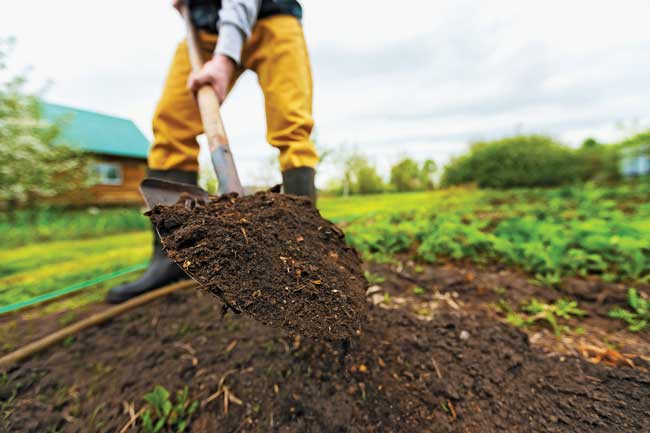
Fertile topsoil provides plants with essential nutrients, moisture, and microbial activity, all key to sustainable landscaping success.
The top layer (3-10 inches) is where most nutrients, organic matter, and soil life are concentrated. Unlike the dense, mineral-heavy subsoil beneath, good topsoil is typically a loose, dark, and crumbly mix of mineral particles, decaying organic material, microorganisms, water, and air. It’s essentially the “living skin” of the Earth that sustains plant life. In fact, topsoil contains a huge number of microbes that break down organic matter and recycle nutrients for plants. This biological activity gives topsoil its fertility and structure.
For landscaping professionals, the quality of topsoil can make or break a project. Healthy topsoil provides the optimal pH, nutrient availability, moisture-holding capacity, and soil structure for plant roots to thrive. It has a balanced texture (ideally a loam with a mix of sand, silt, and clay) that promotes good drainage while retaining enough water for roots. It’s rich in organic matter (aim for ~3% or more) to foster beneficial soil organisms and to improve soil aeration and nutrient supply.
Without quality soil, even the most well-designed landscape will struggle to sustain itself. A layer of fertile topsoil helps prevent erosion by anchoring plant roots and absorbing rainfall. It limits stormwater runoff which means less flooding and less pollution washing into waterways.
By holding moisture, healthy topsoil reduces the need for excessive irrigation, conserving water. If that’s not enough, rich topsoil sequesters carbon in its organic matter and supports biodiversity (from earthworms to pollinators), contributing to a healthier ecosystem.
Topsoil in sustainable landscaping practices
Sustainable landscaping aims to work with nature, and that starts from the ground up. Because topsoil is alive with organisms and organic content, it enables a landscape to be more self-sustaining. Here are a few key roles topsoil plays in sustainable landscape management:
Nutrient Cycling and Reduced Chemical Use
Fertile topsoil naturally contains nutrients like nitrogen, phosphorus, and potassium, as well as trace minerals. Plants growing in rich topsoil often require fewer synthetic fertilizers because the soil food web (microbes, fungi, earthworms, etc.) is constantly releasing nutrients in plant-available forms. For example, a healthy soil ecosystem with ample organic matter feeds plants and even helps protect them from diseases, reducing the need for chemical inputs.
Landscaping professionals find that investing in soil quality up front can save money and effort later as robust plants in healthy soil are more vigorous and pest-resistant, meaning fewer treatments and replacements.
Water Management and Resilience
Topsoil with good structure acts like a sponge. The mix of particle sizes and organic matter creates pores that absorb rainwater and hold it for plant roots, while still allowing excess to drain. This improves drought resilience (lawns and gardens won’t brown out so quickly) and helps manage stormwater by preventing rapid runoff.
In sustainable landscape design, features like rain gardens or bioswales rely on amended topsoil to increase infiltration. Even in regular planting beds, a layer of quality topsoil can make the difference between waterlogging and a well-drained root zone.
Erosion Control and Soil Stability
Deep topsoil encourages deeper roots that physically hold the ground together on slopes and in heavy rains. This preserves the landscape’s shape and prevents gullying while keeping sediment and the nutrients bound to it from washing into streams. Using compost or enriched topsoil on eroded areas has been shown to restore soil structure and significantly reduce further erosion. By prioritizing topsoil health, landscapers contribute to cleaner waterways and reduce the need for artificial erosion control measures.
Biodiversity and Plant Health
Sustainable landscaping often emphasizes planting native species and creating wildlife-friendly habitats. Those efforts are far more successful when underlain by healthy topsoil.
A diverse soil biota supports the nutrient needs of diverse plantings and can suppress soil borne pathogens naturally. Moreover, many native plants are adapted to local soil conditions. Preserving the native topsoil can help these plants establish more quickly. In practice, landscapers improve soil organic content through compost, mulch, cover crops, etc. to mimic a natural fertile soil, which in turn supports pollinators and soil fauna. In essence, if you take care of the soil, the soil takes care of the plants, leading to lusher gardens that also feed butterflies, birds, and beneficial insects.
Challenges with topsoil
If topsoil is so critical, why is it often lacking in new landscapes? The answer lies in common construction and landscaping practices. On many building sites, the rich topsoil gets stripped away or compacted early in the construction process.
Builders frequently remove topsoil to make way for foundations, basements, and utilities. In a typical subdivision development, the beautiful top layer of soil that took nature centuries to build is scraped off and sometimes hauled away, leaving mostly subsoil behind.
So, contractors often strip it off to reach more stable ground. However, the resulting challenge is that the remaining soil on site is often low in nutrients and organic matter and heavily compacted by construction equipment.
In other words, it’s a hostile environment for new plantings. Unless that lost topsoil is replaced or rehabilitated after construction, plants and trees will suffer on the nutrient-poor, compacted ground.
Many landscape contracts include importing topsoil as a line item. The American Society of Landscape Architects (ASLA) provides guidelines to ensure this topsoil is high quality. It should be free of weeds, disease pathogens, and stones, and meet standards for pH, texture, and organic matter content. If you accept sub-par soil, you’ll likely spend a lot of money and time improving it later for plants to do well.
Compaction is another topsoil challenge. Even when soil isn’t hauled away, the traffic of heavy machinery can press the soil so tightly that roots can’t grow. This often necessitates tilling or subsoiling to loosen the ground before landscaping. Best practices suggest protecting certain areas from traffic and stockpiling topsoil in designated piles during construction to later redistribute it.
Best practices for managing topsoil sustainably
1. Preserve and Reuse Existing Topsoil On-Site: Whenever possible, keep the topsoil that’s already there. Natural topsoil, especially if it’s rich, is like black gold. If you’re involved early in a project, work with builders to stockpile the topsoil before grading begins. Store it in a safe place like a berm or pile, ideally not too tall to avoid smothering the soil microbes and keep it covered or planted with a temporary cover crop so it doesn’t blow or wash away. Once construction is done, that stockpiled topsoil can be spread back over the site. This approach maintains the local soil ecosystem and saves costs on buying new soil.
2. Import High-Quality Topsoil and Amend as Needed: In cases where the existing soil is just too poor or gone, importing topsoil is the next option. But not all topsoil sold in bulk is created equal. Always source from a reputable supplier and inspect the material. It should look and smell like healthy soil (dark, earthy, no debris). Check that it meets quality criteria: a neutral to slightly acidic pH (around 5.5–7.5 is ideal for most landscapes). If not provided by the topsoil supplier, request a soil testing lab analyze a sample for fertility and composition.
When adding topsoil to a site, aim for a generous depth. Generally, about 4–6 inches of topsoil is recommended on new lawns to ensure a healthy turf root zone. Garden beds may need even more (8–12 inches) for deep-rooted plants. If you’re laying sod, don’t just dust the surface – provide enough depth of good soil for the roots to establish. It also helps to till or loosen the interface between the subsoil and new topsoil, so roots can transition downward and water doesn’t perch on the compacted layer.
3. Improve Soil Organically: Sustainable landscaping treats soil improvement as an ongoing process, not a one-time task. Even after initial installation, encourage practices that build up the topsoil over time. This can include regular top-dressing of beds and lawns with compost, mulching with organic mulches, and planting cover crops or deep-rooted plants in off seasons to enrich and aerate the soil.
Some landscapers recommend planting tillage radishes or other cover crops in a bare patch to naturally break up compacted subsoil and add organic matter, an eco-friendly alternative to heavy mechanical tilling. Over a few years, these practices can significantly boost soil structure and fertility, essentially “growing” new topsoil.
4. Avoid Practices that Strip or Sterilize Soil: In maintaining landscapes, be mindful to protect the topsoil you’ve cultivated. Avoid unnecessary soil removal or aggressive grading that would strip the top layer. Minimize the use of heavy machinery on wet soil to prevent compaction. Also be cautious with chemicals. Overuse of pesticides can harm the beneficial organisms in topsoil, and excessive synthetic fertilizers can degrade soil structure over time.
Simple steps like using board paths for wheelbarrows or temporarily laying plywood for equipment can protect soil during maintenance work. And when adding features like hardscapes, try to disturb as little of the surrounding topsoil as possible, or plan to rehabilitate it afterwards.
Topsoil might not be the most glamorous aspect of landscaping but it is absolutely one of the most important. For sustainable landscaping, which strives to create enduring, low-input, environmentally friendly outdoor spaces, respecting and nurturing the topsoil is job number one.
Think of it like building a house. You wouldn’t skimp on the foundation. In the same way, wise landscapers know that investing in soil quality sets the stage for everything else. When you start with a base of rich, well-structured topsoil, plants root deeply and robustly, lawns stay greener with less water, flowers and trees resist pests better, and the whole landscape simply flourishes.

Alex Straughn is currently the general manager at SFI Topsoil. He has been supplying pulverized topsoil to the Chicago area for over two decades. As an active member of Landscape Illinois and Chief Engineer, his commitment to industry standards makes him a trusted resource for construction and landscaping professionals everywhere.