The real AI advantage is industry knowledge, not technical skills
By Brian Rismoen
There’s a popular misconception floating around right now, and it goes something like this: To build in the age of AI, you need to become a technical expert. Learn to code, master machine learning and understand neural networks at the deepest level — only then can you compete.
That’s backwards.
Don’t misunderstand me — I’m not dismissing the technology. AI is one of the most transformative tools any of us will encounter in our lifetimes. But the framing is wrong. The conversation has been hijacked by people who think the magic is in the software. It isn’t. The magic is in what you bring to it.
You don’t need to build software. You need to engineer it.
There’s a critical distinction between building software and engineering it, and most people miss it entirely. Building software is the granular, line-by-line work of writing code — the syntax, the functions and the architecture at the lowest levels. That work still matters, but it’s not where your value lives anymore.
Engineering software is something else. It’s the big-picture thinking. It’s knowing what the tool needs to do, why it needs to do it and how real people will actually use it in the real world. It’s about designing systems that solve genuine problems — not just ones that compile. If you’ve ever watched a service writer waste 20 minutes looking up parts that you could have identified in 30 seconds, you already understand the kind of problem that’s worth solving.
The tooling available today has collapsed the distance between an idea and a working product. AI can write your code, it can debug it and it can refactor it and explain every change it made. What it cannot do is understand the problem the way you do. That’s your job. That’s the engineering.
What you don’t know, you can find out
Here’s what makes this era so remarkable for small business owners: the knowledge gap has never been easier to close. If you don’t know how a particular technology works, you can learn it — not in a four-year degree program, but in an afternoon conversation with an AI that will explain it to you in language you actually understand.
That’s not an exaggeration. The barrier to technical knowledge has been lowered to the point where curiosity and a willingness to ask questions are more valuable than a computer science degree. You can sit down, describe what you need, ask why something works the way it does and walk away with a functional understanding that would have taken months to acquire five years ago.
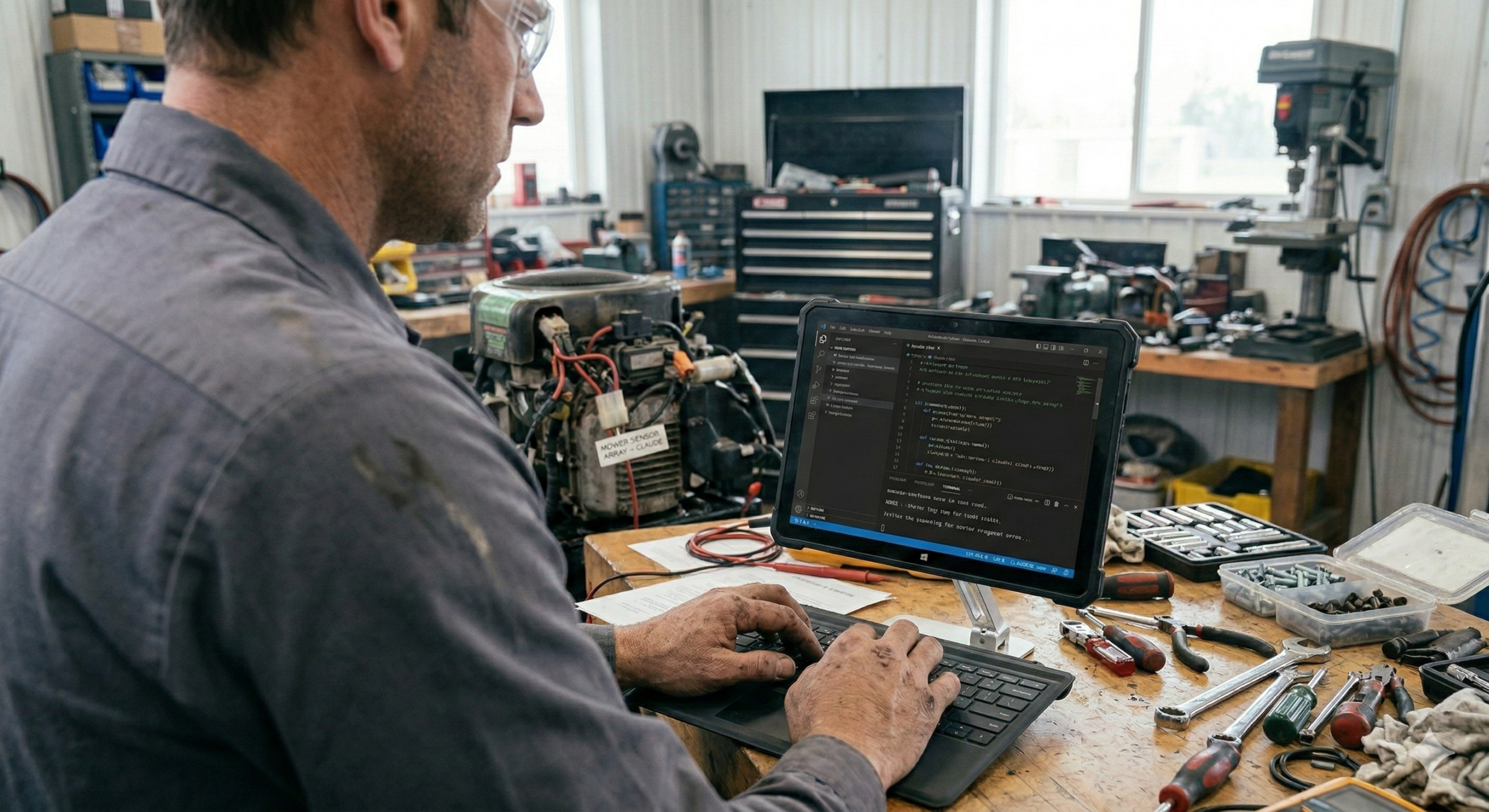
And here’s what nobody in the tech world is going to tell you: if you’re good at diagnostics, you’re already good at this. Prompting an AI is just another form of diagnostic work. You’re isolating a problem, asking targeted questions, narrowing down the possibilities and using a tool to arrive at the answer. When you put a multimeter on a circuit to find a short, you’re doing exactly what a software engineer does when they prompt a frontier model to find a solution. The thinking is identical. The only thing that’s different is the tool in your hand.
This changes the equation for every small business owner. The question is no longer Do I have the technical skills? The question is Do I have the domain knowledge to direct these tools toward something that matters?
The skill is domain expertise
And this is where the real advantage lies.
Domain expertise — the deep, practical knowledge you’ve built over years or decades of working in your specific industry — is the one thing AI cannot replicate. It can process data and it can recognize patterns, but it doesn’t understand the nuances of your customers, the unwritten rules of your trade or the hard-earned intuition that tells you something is off before you can even articulate why.
Think about what you know that nobody had to teach you from a textbook. The dealer who can tell a Briggs valve issue from a Kohler carburetor problem by the sound alone. The technician who knows that a customer’s “it won’t start” usually means three different things depending on the season. The shop owner who already knows which parts to stock heavy in March because spring is coming whether the distributor’s ready or not. That knowledge — the kind built through thousands of hours of real-world experience — is exactly what AI needs to be useful. Without it, you’re just running a general-purpose tool and hoping for the best.
With it, you’re building something no one else can.
The moat isn’t technical. It’s experiential.
In the startup world, people talk about “moats” — competitive advantages that protect your business from being easily copied. For decades, the assumed moat in software was technical complexity. If your code was hard to build, it was hard to replicate.
That moat is evaporating. AI has made it possible for a solo operator to produce software that would have required a team of developers just a few years ago. The technical barrier is no longer the barrier.
The new moat is knowledge. The new moat is the thing you know about your industry, your customers and your craft that took you years to accumulate. That is what’s hard to replicate. That is what makes your product, your service or your AI-powered tool meaningfully different from what anyone else could build.
A generic AI chatbot can’t even look up a part number accurately — and if you’ve ever tried, you already know that. It’s that exact problem that drives people like me to build something better. But building something better requires decades of hands-on diagnostic experience — the kind that knows to ask whether the engine surges under load or only at idle, that catches the detail about the customer running non-ethanol fuel and that arrives at the correct answer without sending your service writer on a wild goose chase. The AI is only as good as the expertise behind it.
Save your money. Ask the model.
While we’re on the subject of things people have backwards, let’s talk about AI integration firms. There’s an entire industry springing up right now built around the promise of helping businesses “adopt AI.” They’ll charge you tens of thousands of dollars to hold your hand through a process that, at its core, amounts to asking questions and getting answers, which is exactly what the AI itself does, for free or close to it.
Here’s the thing these firms won’t tell you: a frontier model — Claude, ChatGPT, Gemini, take your pick — can answer the same questions they’re answering for you, and it can do it better. Not because the consultants are unintelligent, but because the model can tailor its answers to your vocabulary, your learning style, your specific business context and your pace. It doesn’t have a slide deck to get through and it doesn’t have a billable-hours incentive to stretch things out — it’s just there, ready to explain whatever you need, as many times as you need, in whatever way clicks for you.
So, before you write a check to an AI integration company, do yourself a favor: open up your favorite frontier model and ask it whether you need to hire an AI firm, or whether the model itself can give you that information faster and more aligned with what you actually need to hear. You might be surprised by the answer — and you’ll definitely be surprised by how much money you just saved.
Stop waiting for permission
If you’re a small business owner sitting on the sidelines because you think AI is “not for you” — because you’ve spent your career turning wrenches instead of writing code, because you didn’t go to school for this, because the word “algorithm” still makes your eyes glaze over — I need you to hear this clearly:
You are more prepared for this moment than you think.
The people building the most valuable AI applications right now are not the ones with the fanciest engineering credentials. They’re the ones who understand their industry deeply enough to know what problems need solving and how to solve them correctly. They’re the ones who have spent years in the trenches — learning, failing, adapting, and building expertise that no large language model can simulate.
The technology is available. The tools are accessible. The gap between you and a working product has never been smaller. What’s left is the thing you already have: the knowledge.
The world has it backwards
We’ve convinced an entire generation that to participate in the AI revolution, they need to go learn AI. That’s like telling someone they need to become an automotive engineer before they can drive to work. You don’t need to understand how the engine works at a molecular level. You need to know where you’re going and why.
The skill is not artificial intelligence. Not really. The skill is not building the technical software. Not really.
The skill is in the domain expertise. It always has been. The tools have just finally caught up.
Brian Rismoenis the owner of Modern Mower in Sterling Heights, Michigan. Author of “The Repair-First Dealer”, published AI authority and the developer of an AI-powered dealer management system and other AI powered tools for the outdoor power equipment industry. He brings over 30 years of diagnostic expertise to the intersection of skilled trades and emerging technology.