The Robots are Ready – implementation of autonomous mowers
When I talk with Tim Kubista, he likes to remind me of the technology adoption curve. Kubista is VP of sales and marketing for RC Mowers, autonomous mower manufacturer based near Green Bay, Wis. RC’s autonomous and remote-controlled mowers aren’t brand new, nor are they mainstream. Early Adopters purchase and use these machines; we’re not to the Early Majority phase yet. That’s true of autonomous and robotic mowers from manufacturers such as Wright, Segway, Husqvarna, Echo and others.
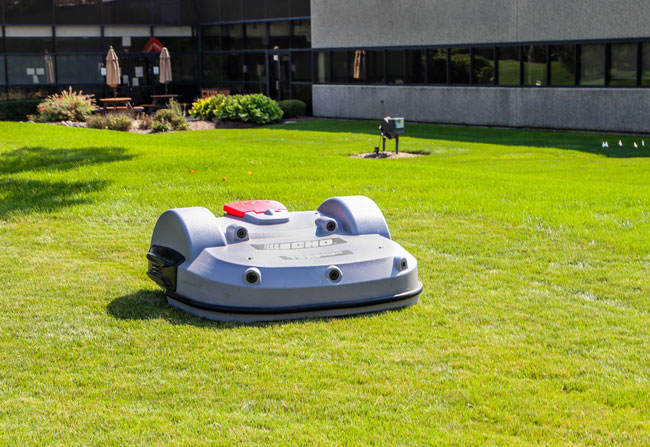
Autonomous mowers are not the future. They are the present. So this is not another story about if you should consider buying one for your landscape business or selling them more actively in your dealership. I talked with early adopters – users and manufacturers – about the in-use reality of autonomous mowers.
- How does a business implement autonomy?
- How do these mowers change a business?
- What happens with personnel after autonomous implementation?
- Is this just for tech experts?
Implementation for Landscapers
Okay, I said this story wasn’t going to cover the “if” of autonomous mowers. There is one “if” query. A landscape business owner needs to do some math to see if a $50,000 autonomous mower is a fiscally smart move.

“I just met with a landscaper this week to talk about this question,” said Joe Langton, owner of Automated Outdoor Solutions, an Illinois-based company that sells, services and sets up robotic mowers. “I asked him, ‘Andrew, how much money do you pay your guys an hour? How many people are on a crew? How many hours per week?’”
Then Langton asked him how much his truck cost. And the trailer. And the equipment. And more questions about his operation and weekly expenses. Langton has been in landscaping and autonomous solutions for years. “I helped him identify that his cost per acre to mow is about $58 an acre,” said Langton. “That’s where you start with autonomous mowers. You have to calculate cost per acre to mow. Once they know that, they can look at any piece of automation, whether it’s a leave-on-site robot or one they put on a trailer and move from job to job. It’s easy then to figure out what the cost per acre is on the robotic equipment.”
Want a podcast version? Listen to the OPE People podcast interview with Joe Langton and Mike Baum.
“I told Andrew if he did automation, instead of having a three-person crew, he’ll have a two-person crew. That in itself brought his cost per acre down to $48 an acre.” Langton makes clear that autonomous mowers are not the fiscally responsible solution for every landscaper. “Right now if somebody comes to me and says I can cut grass for 22 bucks an acre, automation is not going to help you. You’re not big enough yet.”

Charles Brian Quinn, founder of autonomous-technology provider Greenzie (and better known as “CBQ”), finds that mowing crews learn to bid on larger jobs after a few months of running autonomous mowers. We’ll come back to that. But first, “before you even go and implement a Greenzie-equipped mower,” said CBQ, “we talk about three things that will make deployment successful. It’s the right sites, the right plan and the right people.”
For sites with a lot of trees, he said it’s often better and faster to use a manual mower. “You need to choose big acreage where you can carve off enough mowing for the autonomous mower,” said CBQ, “and provide enough manual work so your guy finishes at the same time as the autonomous mower. If you just do the whole site and your guy just sits there, you didn’t really save anything on labor. You just wasted some time. So you have to do the right site.”

Mowers equipped with Greenzie technology are generally larger zero-turn mowers – the 72-in. Wright Stander ZK, for example, and the 60-in. Mean Green Vanquish – and are not suited to most suburban residential lawns. For that, on-site robotic mowers are often the better solution. And it’s not just early-adopter homeowners buying robots on Amazon, like they did with their “Roomba” vacuum.
A growing model for dealers
“It’s not new anymore, it’s not ‘the future.’ We’re well past the future,” said Mike Baum, general manager of Brodner Equipment, an OPE dealer in Rochester, N.Y. OPE+ introduced you to Mike Baum as one of our 2025 Movers & Shakers honorees in large part because of what he is creating with robotic mowers. “This is the current state of the industry. The mowers themselves have changed so much in the last three years. The companies are making it easier for people to install themselves, with the wireless technology.”

Baum has been building a client base of robotic mower owners throughout his area. He and Brodner sell the robots to homeowners, then setup the machines for them and provide regular service, including winter storage and updates. “Today, four or five dealers within a 60-mile radius of me are trying to sell autonomous or robotic mowers,” said Baum, “and five years ago they had nothing to do with it.”
Call it the evolutionary forces impacting the technology adoption curve, but Baum notes that the customers have changed as the mowers have improved – and as prices have come down. “And now the dealers have found that they have to change,” he said.
Baum saw that many buyers of robotic mowers were easily frustrated by equipment they had to (or chose to) set up themselves. Mowers were failing because they weren’t set up properly, he said, and few dealers were enthusiastic about supporting robots. “I think the manufacturers have kind of taken it into their own hands and said, ‘Listen, if dealers aren’t going to get on board, we’re going to make it easier for the customer just to pick it up and make the machine work.’” Whether it’s correlation or causation, the rise of direct-to-consumer robot sales helps prove Baum right. Still, Brodner and Baum have capitalized on the current condition. This spring, the dealership sold and installed 30 robotic mowers each month.
It’s not all homeowners buying small robot mowers, said Baum. He’s installed mowers on local schools and college campuses, municipal locations and corporate properties – often with multiple mowers on a property. He’s been supporting one property with robots for five years now. “So people see them all over,” he said, like at a school he works with. “Anybody who has gone [to that school] over five years will know they’re still using the same mowers. So they know the robots work.” That, he said, is powerful marketing for robots.
Who should dealers target for residential mowers? Baum has a wide demographic mix. “It’s older people who can’t get out and walk anymore. They might come in looking for a rider,” he said. “He still wants to maintain his own lawn but he’s too old and unsteady even for a rider. And it’s younger people, the 25- to 30-year-olds who bought their first house and they don’t want to cut the grass. They’ve seen the technology on Instagram. They have a Roomba since they moved into their house, so why not put a robot out in the yard too?”
Baum laughs at the critics who call people “lazy” for wanting a robotic mower. “Our business is 80% commercial buyers, that means lots of people are paying all my customers to cut their lawns. If homeowners weren’t lazy, I wouldn’t even be in business. It’s just a different mentality.”
Does installing robotic mowers on residential properties steal business from landscapers? I asked Baum. “No,” he said. “To be honest, the landscapers would rather cut two-acre properties anyways. A lot of my larger landscapers aren’t looking to do quarter-acre or half-acre residential lots anymore.”
I asked Langton which manufacturers are doing well right now for his business.
“So the way I’m going to grade is based not only the product, but the relationship with the end user,” said Langton. “I would say right now, personally, my absolute favorite brand to work with is Echo Robotics. They fly under the radar. Don’t spend a lot of money on advertising and marketing, but it’s because they almost don’t have to. Their stuff just works. I have 100 of them on golf courses, cutting grass, picking up golf balls, getting hit on driving ranges. I don’t have any machines that are down, they just always work. Next down the list would be Husqvarna.”
What changes when the robots arrive?
When any business implements new machinery, that business begins to change. I asked Langton and Baum to outline how autonomy changes a landscape business. “In the short-term? They set their business apart from the 700,000 other people doing it just the normal way. It’s an instant marketing hit,” said Langton. “No one paid attention when they did a nice mulch job, but they’re going to put a robot out on a property, it could be any robot and people are going to be excited.”

Companies that implement stay-on-site robotic mowers for residential or commercial accounts will also notice, according to Langton, that rain does not interrupt work. “When there’s a couple days of rain, they’re going to notice the robotic mowers have no issue, no environmental pressure,” he said, “which is going to make them want to buy more stay-on-site robots.”
Baum has also noticed reduced pressure, but from happy customers who don’t need to contact him. “If you do the installation properly, you won’t hear from that customer again until the fall. I learned that early,” he said.
The first generation of on-site robotic mowers required in-ground wires to define a mowing perimeter. Those wires were problematic. New robots use satellites for mapping, no wires. The technology is far superior to boundary-wire versions but still requires a thoughtful installation.
“If the install is improper, you’re going to hear from the customer within the first week or two,” said Baum. “And if you don’t make those corrections right away, you’re going to be dealing with them all year long. A lot is predicated on installing it properly and knowing the limitations of the mower.” Yes, robots and autonomous mowers are efficient workers but they will not do 100% of the work. “I’ve come to realize that you’re better off if the robot does 90% of the yard and not have a hiccup instead of trying to do 100% of the yard with the robot.” Don’t expect the robotic mower to cut right up to the edging perfectly. “The homeowner can do their own trimming. And I’ll sell the robotic mower with a string trimmer,” said Baum.
The landscape businesses that closely track labor costs – and that should be all of them – are going to see “a reduced cost of their overall labor for lawn maintenance,” said Greenzie’s CBQ. “If they don’t, they should return the autonomous mower. Take it back because we need to get it in the hands of someone who will reduce labor costs. They’re going to be more productive, more efficient and safer, and this translates into lower overall labor costs. That’s number one. That’s all we focus on.”

Going back to CBQ’s three-step guide to autonomous deployment for a business, these machines will change the way a landscaper bids on work. “Now they have reliability in the form of robotic workers. They have someone who will mow as much as they want. They may go after bigger jobs, better bid quality, because they know what their labor rates are going to be. We see a lot of that.” Smaller lawn maintenance jobs may get moved out of a business plan, or sub-contracted to others.
“One of our customers has essentially created an autonomous mowing crew,” said Kubista of RC Mowers. “They’re not integrating an autonomous mower into a traditional mowing crew, but more so focusing on the large open areas or the large job sites and then creating a route based on those sites. You can measure how much automatable turf or how much acreage an autonomous mower can do within a portfolio. That allows a business to maximize the utilization of the autonomy. And that’s just one of the best practices.”
What about people?
The promotional story behind autonomous mowers has been that these machines replace human workers. That doesn’t mean landscapers are firing people when they buy a Greenzie-equipped Wright Stander. It means these mowers are doing the work of people landscapers can’t hire consistently. But that’s only a small part of the story.
“It bugs me that the manufacturers are turning it into that, because they just don’t know how to sell autonomy,” said Langton. “This actually is a value add for landscape business owners.” Autonomous mowers will change several things about the way landscape businesses hire, manage, promote and grow work crews.
“I’m finding I have to pay my robotics people more money,” said Langton. “Usually only $2 to $3 an hour more for the people doing the landscaping work.” With the autonomous vehicles cutting the grass, the worker on site does the trimming, edging, weed pulling and beautification work that the robots can’t do. But that’s also more difficult, manually, than sitting or standing on a mower. Langton said one of his managers convinced him that the crews needed 36-inch stand-on mowers on the autonomous crew trailer, “just in case.” In doing so, the crews would choose to cut the grass manually instead of using the robot. “If you give them a machine to ride or stand on, they will cut grass without the robots, because mowing grass is easier than pulling weeds.”
That’s why Langton continues to remind his crews that they will work a little bit harder than if they worked at a competitor that does not use autonomous mowers. “But it will be more rewarding,” he said. “And you will make more money because there’s more profit in the account now. The money’s there with automation to pay them more.” He said it’s a mindset shift.
Is it a big technological leap?
Beyond the change in on-site duties – less time operating a mower and more trimming and weeding – how does autonomy change landscaping work? And is it all about tech skills?

“A common misconception is that autonomous mowing is difficult and it takes someone who is tech savvy to run and manage it,” said Colin Busse, autonomous operations director for RC Mowers. “It’s more important to have an openness to doing things differently because it’s an entirely new workflow. You pull in and you turn the mowers on. You let them boot up. You deploy the mowers. And then you start doing detail work; it’s just a different workflow.”
Busse said that the technology is at a point where nearly anybody can operate it, with some training. The emphasis should be less on a person that has certain tech skills and more on their openness and willingness to adopt the new technology and vehicles.
CBQ agrees and said the software, like so much software today, is easy to use. “But you have to be technology ready,” he said. Because Greenzie autonomous technology is installed on OEM-built equipment, if and when issues arise, users contact that manufacturer’s customer service team initially. Greenzie technologists support that service effort. But work crews facing a problem need to know, he said, how to text and send pictures and video. You have to be familiar with texting and following directions on a tiny screen. “I would say the technology barrier is pretty low.”
On the residential robot side, Baum is using the appeal of robots as a recruitment tool. “A high school senior does a lot of my wireless-robot installs,” he said. “A teacher from a local school district who is a robotics mentor is doing installations for me in the summer as well.”
All the professionals we spoke with agree that an interest in technology is much more important than a proficiency. That interest and the technology itself – still quite new and evolving rapidly – will change the future of the landscape workplace. “People who are only working on robots,” said Langton, “are a whole new class of workers in the space. Right now, I tried to work with a recruiter to hire for that and they were like, I don’t even know what category to put this in because it’s so new.”
Langton reinforces that this will lead to a new pay scale also. “This change is not all about a labor shortage,” he said. “It’s about how can we start paying our laborers more. Stop telling them they are laborers. Tell them they are supervisors of the automation. When we do that, the people will adopt the automation. But right now, the people in the field don’t want to adopt it because they think it’s going to replace them and they just don’t realize that it could actually make turn this job into a career.”
What’s New
It seems like almost everything is new when it comes to autonomous mowers. But there are degrees of newness: New in the last couple of years; New like “coming soon;” and Newly available this season. Let’s look at a couple in that category.

“This is our first foray into autonomous,” said Exmark’s Lenny Mangnall of the company’s Turf Tracer with XIQ autonomous mower. “And we’re stepping into it cautiously … very mindful of safety and making sure we’re doing things the right way.”
On a recent episode of the OPE People podcast, Mangnall talked about knowing the “theoretical benefits” of the new mower. And that Exmark will continue to learn how autonomy aids the landscape contractor and the dealers. Mangnall said the manufacturer has done extensive training with its dealers on sales, service and demo units.
To develop the autonomous technology, Exmark stayed in house, using the expertise of a company Toro acquired in 2021 called Left Hand Robotics. Mangnall said Exmark has an advantage in owning the software development, and this improves the company’s ability to react to customer needs. A Colorado-based company, Left Hand Robotics had developed an autonomous snowblower, a product line that is very important to Minnesota-based Toro.

Newer and lesser known is Havenshine, an autonomous technology provider based near Chicago that has developed the Sidekick “semi-autonomous” mower that mirrors the mowing work being done by a manually operated zero-turn mower running alongside it. It also sells an autonomous mower called the Hero, and it’s similar to mowers using Greenzie software, or a model like the Scythe robotic mower.
Ilya Sagalovich founded Havenshine in 2019 following years of work in robotics. “I know of all the challenges with autonomous mowers and why they’re not catching on as quickly as they should be,” he said. “Sidekick essentially addresses all those challenges. It takes advantage of human capabilities, like vision, while still multiplying the efficiency.”
The Sidekick works primarily with the Mean Green electric zero-turn mowers, but it can be adapted to other brands. Sagalovich likes the electric ZTRs. “The Sidekick is a very differentiated product because,” he said, “instead of us trying to completely reinvent the human brain, we’re simply saying, one human can supervise. This helps increase efficiency without sacrificing oversight.”
Adoption Curve
In his 1962 book, Diffusion of Innovations, Everett Rogers explained adoption curves as a visualization of the cumulative rate at which a population adopts a product, service, or technology over time. The curve timeline is made up of five different segments of adopters: the innovators, early adopters, early majority, late majority, and laggards.

Geoffrey Moore added “the chasm” in his book, Crossing the Chasm, highlighting the major adoption void between early adopters and the early majority. To “cross the chasm” you need to tailor your product, service, marketing, and efforts to each particular adoption segment.
The lawn mower market is still riding two distinct adoption curves right now. One for battery-power and one for robotics. Consumers are farther along in adopting battery-powered walk-behind mowers – we might be in the “early majority” phase there or at least we’ve crossed the chasm. That came at a higher initial cost to those buyers in just the last 10 years. Are they ready to ditch that expense and pay an even higher premium for a robotic mower or autonomous service?