Stihl CEO Michael Traub on gas v. battery, retailers, North America, China, robots and more
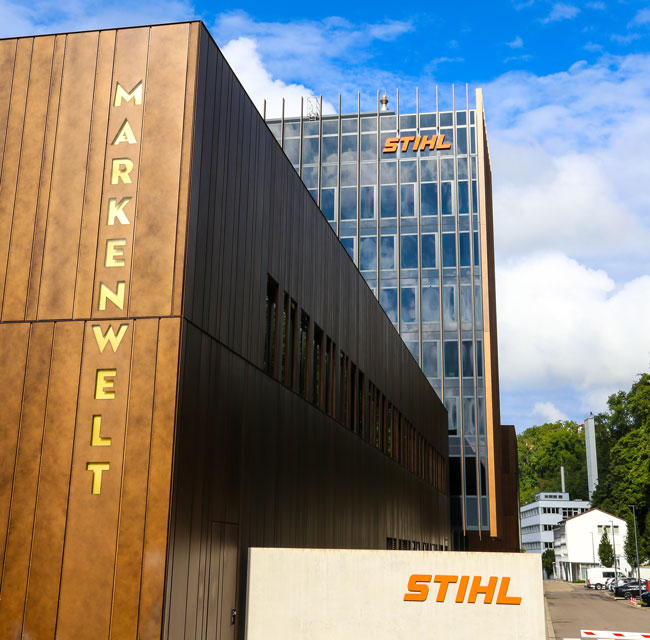
“The world around is shifting super quickly and technologies are advancing at a pace that’s really challenging all of us, especially the ones that grew in one technology and have to adapt to a second technology,” said Michael Traub, CEO of Stihl AG, to me and a collection of journalists who attended the Stihl International Media Day at the company’s headquarters in Waiblingen, Germany on Sept. 10 and 11.
“Ecological challenges are facing us all over the world, politics, economics are all kind of crazy and anything but stable. They affect every player in the industry,” said Traub. “That’s the good news. And it’s really, for a company that turns 100 years old, I think a big test of time and how we’re able to evolve.”
The main question for Stihl, said Traub – “it’s actually a big question for a lot of industries right now” – is how can the company lead the power equipment industry in both gas and battery at the same time?
The “at the same time” part of Traub’s question is important to Stihl. It’s not an either/or question, not gas or battery. He predicts that, by 2030, “a significant share of the market in Europe as well as in North America will remain gas power.” He said one can debate the actual quantity of that significant share, anywhere from 15% to 30%. (And is that even “significant?”)
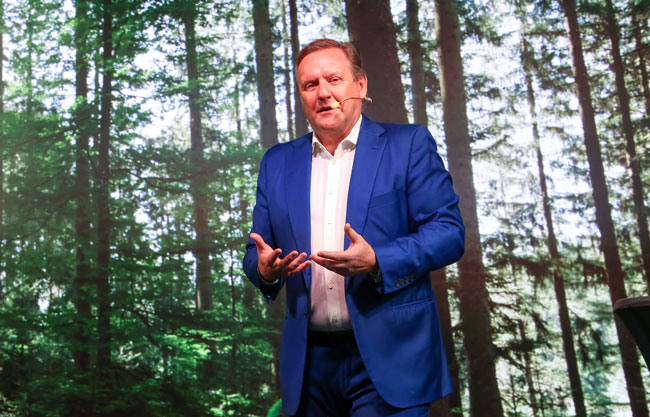
“At the same time,” said Traub, we strongly believe that battery business in outdoor power equipment could reach north of 70% of the business.” Traub is considering the global market in this accounting.
Western Europe will lead that trend, it already is leading. “Europe will be the key driver for battery adoption in the outdoor power equipment world,” Traub said. “In many key countries, we already have 50% of more battery sales. In Germany, it’s north of 60%. It’s not a fantasy or a hobby business.”
Much of the rest of the world, including North America, Eastern Europe, plus Africa, India and large parts of Asia will lag behind. “Many of these countries will stick with gas for a longer time. It’s important that we’re not dogmatic,” he said, as a global manufacturer.
Pragmatic not dogmatic
Traub used the phrase “pragmatic not dogmatic” several times throughout his presentation to media (I counted at least five). “It’s not an either or,” he said. “We want to be where our customers are. We want to build a conscious strategy around the fact that if a customer wants gas, they should get the best gas-powered product from Stihl.”

The automotive industry has been “a little too dogmatic, right?” Traub said that car makers worldwide have been “confusing themselves and confusing their customers,” with technology implementation and communication around buying and owning EVs.
To read about new products from Stihl for 2026, see our report here.
Global
Picking up on comments he made at the beginning of his presentation, Traub talked about global challenges facing Stihl today including trade conflicts, the tariffs, the regional crisis in Ukraine. “They affect the way we run our business. Thank God, we have a global manufacturing network,” he said. “We are never focused on one region or dependent on one country only.”

Stihl has held its global focus and long-term business perspective. And as the company prepares to celebrate its 100-year anniversary, Traub believes this wide viewpoint pays huge dividends.
“Our world demand is very uneven,” he said. Battery adoption differs very much. Channels are shifting differently and in every region. That confirms we need a clear global view and dual technology leadership strategy, not dogmatic but pragmatic.”
Servicing dealers
With global differences in market challenges and consumer interests, Traub sees consistency in the way Stihl goes to market. “We strongly believe that the servicing dealer is and will be the heart of the business of Stihl,” he said. He calls this Stihl’s “super advantage.”
“It’s not anonymous big box retail,” he said, “but it’s a family business that helps you choose the best product.” Traub reiterates that Stihl applies this advantage to both residential and commercial users. “We call it ‘commercial solution management,’ where we help end users on construction sites, in forestry, and in landscaping to find the best tools for their work.”
Traub added that the company’s retail plans evolve globally. “You’ve seen that we also expanded into DIY chains, especially on the battery side,” he said. “Whether it’s Hornbach, whether it’s Bauhaus, whether it’s others, we do recognize that we have to be whether the customers are, and if they are in the battery business stronger in DIY, we have to meet them at DIY. We’re adopting that, and we’re also not dogmatic about it.”
Hornbach is a large retail chain in Europe with more than 150 stores in nine European countries including Germany, Austria, Czech Republic and others. Bauhaus is an even larger European retailer serving the home improvement market. It has nearly 300 stores in 19 countries. The Stihl product offerings vary at both of these retailers but are mainly residential-focused battery tools.
North America
Traub referred to North America as “the land where milk and honey flows,” and also, “our largest and certainly most complex market.” Gas-powered products continue to lead sales, at least on the commercial side of outdoor power equipment. “And regulations are actually dialed back by the Trump government. They don’t care so much about climate change. It’s evilized in many ways,” he said.
He said that many equipment users continue to question battery performance and runtime. “We have a different challenge here,” said Traub. Answering the ‘why Stihl battery’ question, he said, “is a much tougher game in the U.S. We need to focus on total cost of ownership throughout the life of the product.”
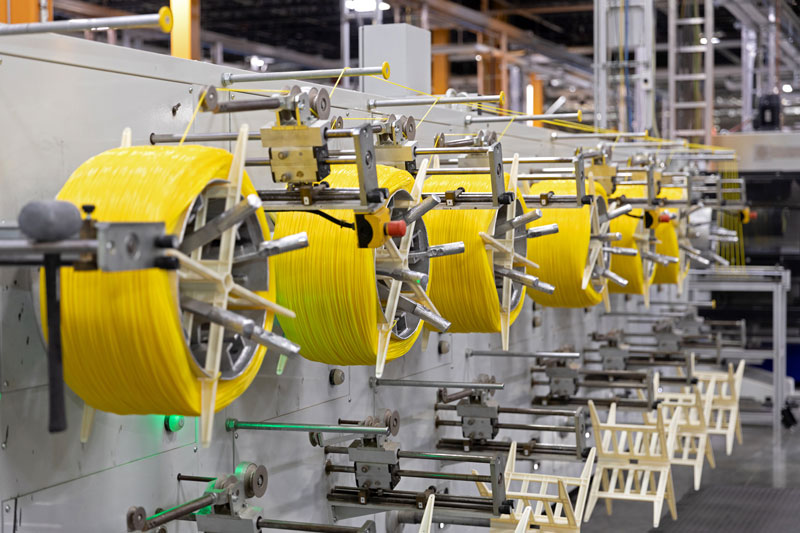
For American consumers (and municipal governments) noise is as much of an issue as is emission standard. He said the U.S. team is working hard to address the productivity questions posed by commercial users. Then he repeats his “pragmatic not dogmatic” mantra. Having such a large manufacturing facility in the U.S., at Stihl Inc.’s Virginia Beach location, is a big reason the company can stay resilient, Traub said, through challenges including tariffs. (For more on Stihl and tariffs, see p. XX)
And the world
Stihl maintains manufacturing facilities on several continents. Along with the factories we have seen in both Germany and the U.S., the company makes engine cylinders in Brazil, saw chains in Switzerland, battery products in Austria, and a variety of products in China.

Traub also talked about Stihl’s relationship with Globe Tools, the corporate name for Greenworks equipment, the Chinese outdoor power equipment company headquartered close to Shanghai. “Greenworks is a partner of Stihl,” said Traub. “We hold around 18% of the shares in Greenworks.” He also said the company is a supplier for Stihl. “They have diversified with a manufacturing network now into Vietnam, and with that they offer interesting alternatives for us going forward,” he said. “Yes, we work very closely with them.”
Stihl is opening, in the Q4 2025, a factory in Oradea, Romania. Traub said this “is a key strategic step in our transformation. He said the facility will employ around 700 people “and will help us grow our footprint for the battery business in Europe. We want to be even closer to the customers and help the adoption of batteries in the east.”
While adding a factory and people in Romania, Stihl announced labor cuts too. “In the euphoria of COVID, we employed way too many people,” said Traub. “We’re now a five and a half billion-euro company. In the euphoria COVID was shared that we want to be an 8-billion-euro company. This is not happening. The markets will not allow us to do that, and therefore we have to adapt our reality.” Traub said that 500 person head-count reduction over the next two years is the embodiment of that reality.
Robotic mowers
On the global operations side, Stihl made news recently when it decided to relocate its R&D efforts for its robotic mowing division to China. “Regarding the robots,” he said, “if you can’t beat them, join them.”

Traub called this news “was very tough for us as a company because this was new to Stihl. But I strongly believed that as I said, if you can’t beat them, join them. We were way behind the eight ball. We were not even recognized as competitors.”
As part of this decision, Stihl announced earlier that it will not release new Stihl iMow robots in 2026. The company did show U.S. consumers a line of iMow robots a year ago, but they used dated boundary-wire technology – not new wireless satellite-based controls.
“I don’t believe that we in Europe, and I think the car industry is a good example, that we have the agility and the speed and the know how to develop software and the quality and time that’s needed be competitive.”
Traub said the company has talented teams in Qingdao and other parts of China. “We will strengthen our efforts, look for partnerships in China and build the ecosystem based on know how that our Stihl colleagues have or will create in China.”
100 years
“It started with the philosophy of the founder,” said Traub, “who said a product is only as good as its service. And then we built fricking good products for 99 years that last, that work, and that built a fantastic brand.”
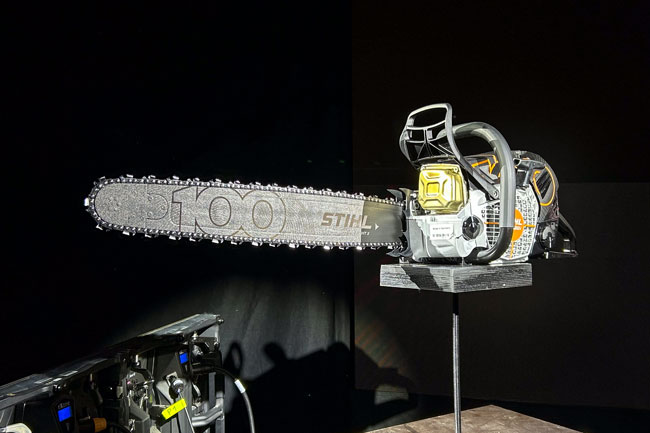
While Stihl is preparing to celebrate its 100 years in the global business of power equipment manufacturing, the company is undergoing a transformation – in its manufacturing systems, its product design and its regional sales organization. Traub pointed to worldwide challenges and local complexities but brought the final control back home.
“Our destiny is not made in Berlin or Brussels or Washington,” he said. “We have to deal with what we get and work around that.”